UPDATED OCTOBER 2026 | 9-STEP BUYING GUIDE | STANDARDS, SPECS AND PRICE BANDS
How to Choose a Sewing Machine: A Buying Guide for Indian Homes
Not sure which sewing machine to buy? This guide gives you a simple decision path: what you plan to sew, which machine type fits, which features matter, which ones are marketing, what the Indian standards say, and what to check before you pay.
Quick Answer: How Do You Choose a Sewing Machine?
Choose a sewing machine in this order: (1) decide what you will sew, (2) pick the type that fits that work, (3) check only the features you will use, (4) set a budget band, and (5) confirm warranty and service near you. For most Indian homes doing alterations, blouses, kurtas and curtains, a mechanical or electric machine with a straight stitch and zig-zag, reverse stitch, adjustable stitch length and tension is enough. Extra stitch patterns, touch screens and embroidery add cost but little value for beginners.
- Alterations, hems and masks only: a hand-operated or mini machine is enough (see the best sewing machine under 5000)
- Regular home stitching: a mechanical or electric straight stitch plus zig-zag machine
- Frequent, creative or bulk work: electronic or computerised machine, or a semi-industrial model
- Business use all day: an industrial machine, not a home model
- Before you pay: check warranty terms, service centre in your city and a BIS (ISI) mark where it applies
The Decision Path in 4 Steps
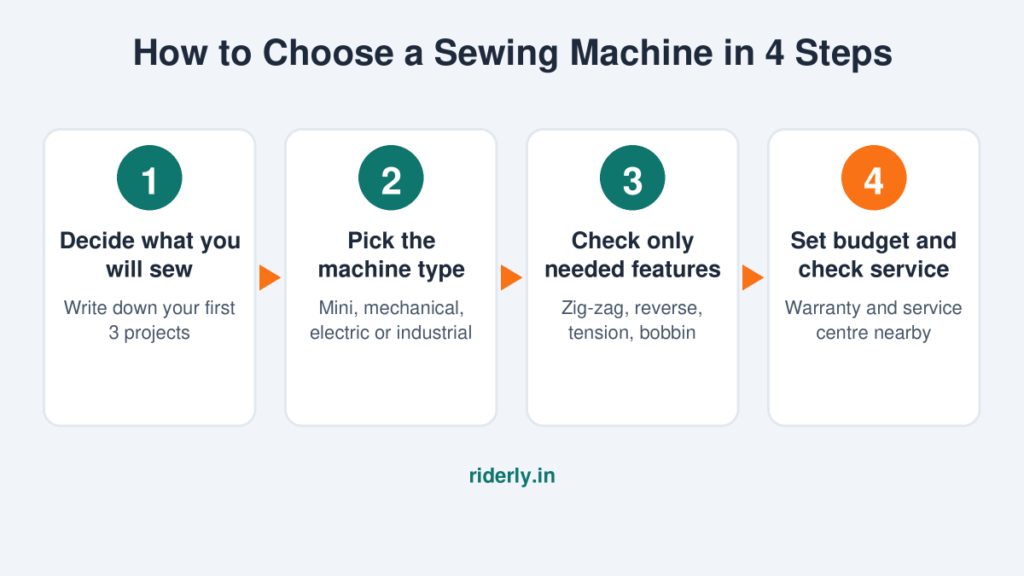
Below, the same path is expanded into 9 practical steps. Follow them in order and you will not need to compare dozens of models.
What Is a Sewing Machine and How Does It Work?
A sewing machine is a device that joins fabric with thread using a needle driven up and down by a motor or a hand wheel. Most home machines make a lockstitch: one thread comes through the needle, a second thread comes from the bobbin under the plate, and the two interlock at each needle hole. This is why a lockstitch can be sewn anywhere on the fabric and not only near an edge (Wikipedia: Sewing machine).
The speed gain is large. Published figures cited on the same reference page put a hand-sewn man shirt at about 14 hours, against about 1 hour on a machine, and a pair of summer trousers at nearly 3 hours by hand against 38 minutes by machine. That is why even a basic machine pays for itself if you stitch regularly.
Step 1: Decide What You Will Sew
This single decision removes most of the confusion. Match your top 3 projects to the list below, and ignore every feature that does not appear in your line.
- Alterations, hems, masks (light to medium cotton): hand-operated or mini electric. Needs reverse or backtack and adjustable stitch length.
- Blouses, kurtas, salwar (cotton, silk blends, rayon): mechanical or electric zig-zag. Needs adjustable tension and an easy bobbin.
- Curtains, bed sheets, bags (medium to thick): electric or heavy-duty home machine. Needs a strong motor, metal frame and higher presser foot lift.
- Jeans, denim, upholstery (heavy): heavy-duty or semi-industrial. Needs metal gears, 90/14 to 110/18 needles and speed control.
- Stretch wear, tees, leggings (knits): zig-zag or overlock machine. Needs stretch or ball-point needles and adjustable presser pressure.
- Embroidery, monograms, lettering: embroidery or computerised machine with hoop support and design memory.
Step 2: Pick the Right Type of Sewing Machine
Usha, the Indian manufacturer, groups home and trade machines as manual or mechanical, electric and automatic, computerised, industrial and embroidery, and rates the skill level each one suits (Usha guide to machine types). The table adds a plain-language view for Indian buyers. Price bands are indicative street prices and change often, so confirm them on the seller page.
| Type | Best for | Indicative price |
|---|---|---|
|
Manual or hand-operated |
Alterations, repairs |
Under Rs 3,000 |
|
Mini electric |
Light fabrics, travel |
Rs 1,500 to 5,000 |
|
Mechanical straight stitch |
Daily stitching, tailoring |
Rs 4,000 to 9,000 |
|
Electric zig-zag |
Mixed home use |
Rs 9,000 to 18,000 |
|
Computerised |
Creative, frequent sewing |
Rs 15,000 and above |
|
Embroidery |
Monograms, decorative work |
Rs 30,000 and above |
|
Industrial |
All-day business sewing |
Rs 12,000 to 40,000 (head) |
Rule of thumb from our review approach: if you are a beginner or sew a few hours a week, a mechanical or electric zig-zag machine gives the best value. See current picks in our Top 10 Best Sewing Machine For Home In India.
Step 3: Check the Stitches That Actually Matter
Do not compare machines by the number of built-in stitches. Most home sewing uses 4 to 6 stitches: straight, zig-zag, a stretch or overlock-style stitch, a buttonhole and a blind hem. The Indian standard for household zig-zag machine heads (IS 15449 Part 1) sets the basics: a two-thread lockstitch, single-needle or twin-needle operation, reverse feed for backtracking, and adjustable upper and lower thread tension (IS 15449 summary).
- Straight stitch: joins seams and does topstitching. Everyone needs it.
- Zig-zag: finishes raw edges and sews stretch fabric. Most home users need it.
- Reverse or backtack: locks the seam start and end. Everyone needs it.
- Adjustable stitch length and tension: lets you handle thin cloth, thick cloth and gathers.
- Buttonhole and blind hem: useful for shirts, blouses, trousers and curtains.
- Decorative patterns: looks only, so treat them as optional.
Step 4: Features Worth Paying For (and Ones to Skip)
Consumer Reports, in an archived buying guide, lists useful features such as an automatic buttonholer, needle threader, needle-position setting, adjustable presser foot, speed control and a top-load bobbin, and advises checking that the foot pedal responds smoothly (Consumer Reports sewing machine buying guide, archived 2016). Use it as a checklist, not a shopping list.
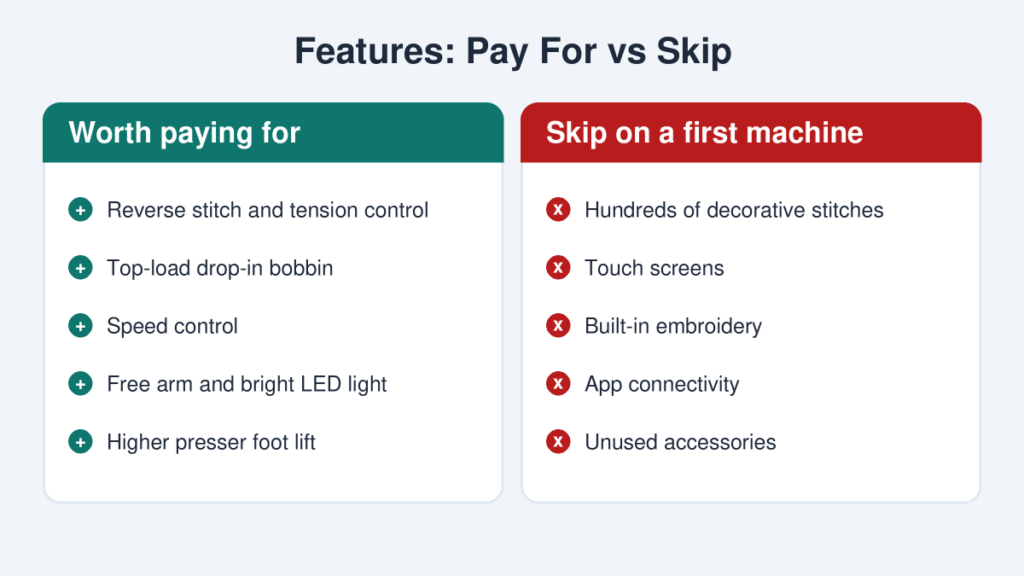
- Useful but optional: needle threader, automatic bobbin winding, needle up-down, extension table
- Never skip: reverse stitch, tension control, and a stable base that does not walk on the table
Step 5: Look at Build Quality, Weight and Motor
Build quality decides how long a machine lasts. A heavier metal frame vibrates less on thick fabric, while a light plastic body is easier to carry. Choose weight based on where the machine will live.
- Mini or hand-operated: about 3 to 3.5 kg (for example the mini machines in our under 5000 guide), mostly plastic. Good for light repairs and travel.
- Home mechanical: roughly 6 to 10 kg with a metal or metal-reinforced frame. Good for daily stitching.
- Heavy-duty home: roughly 8 to 12 kg with a full metal frame. Good for denim, canvas and curtains.
- Industrial head: roughly 25 kg and above with the table, cast iron. Made for full-day production.
Weights above are broad class ranges for comparison and vary by model. Always read the exact weight on the product page. For motors, look for a rated wattage, a smooth speed range and a thermal cut-out; the listing should state these, and if it does not, treat that as a warning.
Step 6: Needles, Thread and Spare Parts Availability
Needle size follows a pair of numbers such as 80/12, where the first number is the metric size and the second is the US size. Schmetz, a leading needle maker, lists universal needles from 60/8 to 120/19 and denim or leather needles from 70/10 to 110/18 (Schmetz needle guide). Buy a machine that accepts standard household needles so you can find them in any local market.
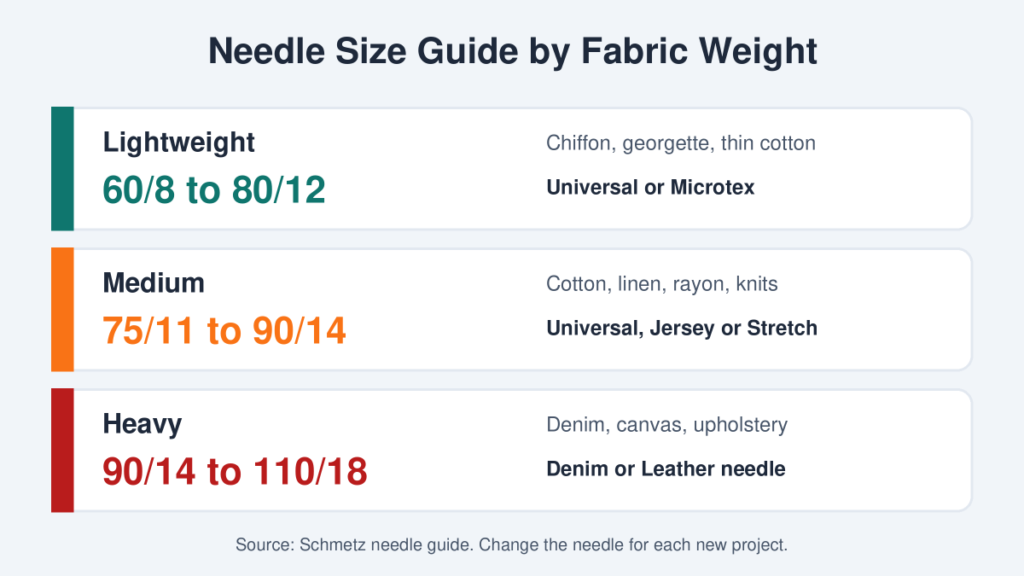
Change the needle at the start of each new project or fabric type. A blunt needle causes skipped stitches and puckering more often than a faulty machine does.
Step 7: Set a Budget Band
These bands are indicative street prices seen across Indian marketplaces and brand stores. Prices move with sales, so treat them as a planning guide. Spend on build quality, service support and the stitches you will use, not on pattern count.
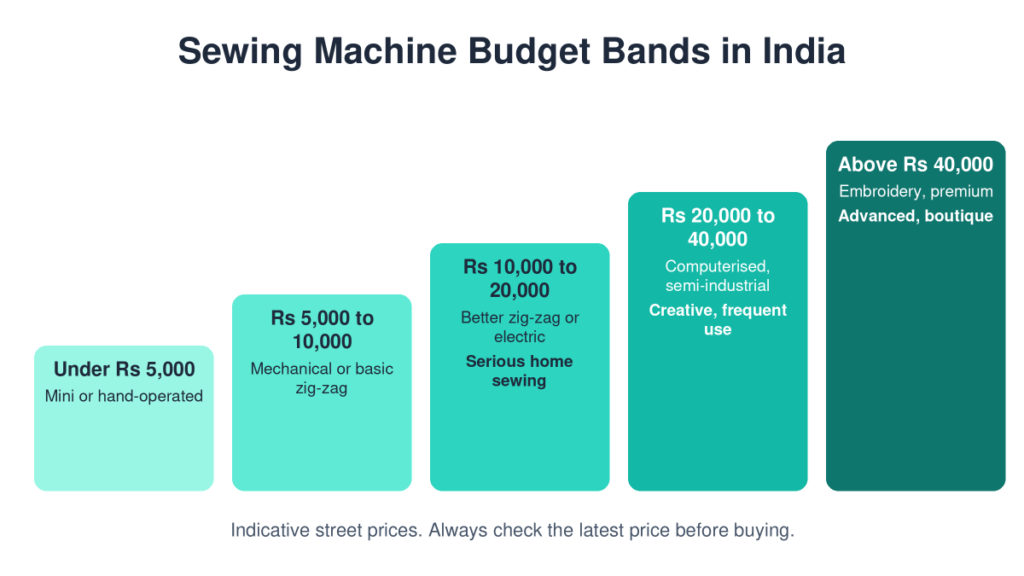
Our latest shortlist is in the best sewing machine for home in India guide.
Step 8: Check Indian Standards, Warranty and Service
The Bureau of Indian Standards (BIS) publishes standards for household sewing machines, including IS 7493 on durability requirements and IS 9874 on arm and bed assembly (BIS: IS 7493, BIS: IS 9874). The ISI mark on a machine head is a sign it was made to a BIS standard, though marking rules depend on the product scheme at the time, so check the current BIS notification if this matters for your purchase.
- Read the warranty period and what it excludes (motor, foot pedal and plastic parts are often treated separately)
- Find an authorised service centre in your city before buying; Usha, for example, lists a store locator and a care helpline on its site (Usha Sew)
- Keep the invoice and note the serial number
- Use authorised repair only; unauthorised repair can void the warranty
- Check that the manual comes in a language you read
Step 9: Final Checks Before You Pay
- Ask for a demo on a layered piece of your own fabric: straight line, curve, zig-zag, reverse
- Thread the machine yourself. If threading and bobbin winding feel confusing in the shop, they will be worse at home
- Run the pedal slowly. A good machine can sew slowly without jumping
- Check the return and replacement policy for online orders, and photograph the unboxing
- Confirm the box contents: extra needles, bobbins, presser feet, screwdriver, oil, cover, manual
- Compare the final price with the seller page on the day you buy, as listed prices change
7 Common Mistakes to Avoid
- Buying by number of built-in stitches
- Choosing the cheapest machine for thick fabric such as denim
- Ignoring the service centre distance
- Buying a computerised machine as a first machine without a plan to use it
- Skipping the demo or the unboxing video for online orders
- Using the wrong needle size and blaming the machine
- Never reading the manual or oiling the machine, which shortens its life
Quick Picker: Which Machine Should You Choose?
- Beginner on a tight budget: mini or hand-operated, or an entry mechanical machine. Start with the best sewing machine under 5000.
- Learning tailoring at home: mechanical or electric zig-zag with a metal frame. See the Top 10 best sewing machine for home.
- Mostly alterations: mechanical straight stitch or a compact electric machine.
- Running a small business: heavy-duty or semi-industrial. Our industrial machine guide is coming soon.
Sources and Further Reading
We built this guide from published standards, manufacturer guidance and reference pages. Riderly has not tested every machine mentioned here.
Frequently Asked Questions About Choosing a Sewing Machine
Start from what you will sew, then pick a mechanical or electric machine with straight stitch, zig-zag, reverse stitch, adjustable stitch length and tension. Avoid paying for hundreds of decorative stitches. See our top 10 list for home use.
For most households, a mechanical or electric zig-zag machine with a metal frame offers the best balance of price, reliability and ease of repair. Hand-operated and mini machines suit alterations only.
Most home sewing uses 4 to 6 stitches: straight, zig-zag, stretch, buttonhole and blind hem. More patterns are mostly decorative.
A basic dependable home machine typically sits in the Rs 5,000 to Rs 10,000 band (see the best sewing machine under 10000), while better zig-zag or electric models fall around Rs 10,000 to Rs 20,000. Prices vary by seller and season, so check the latest price.
A mini machine is worth it for small repairs, hems and light fabrics, but it struggles with thick cloth. See our best sewing machine under 5000 for options.
BIS publishes standards for household sewing machines, such as IS 7493 for durability. Whether a certification mark is mandatory depends on the current BIS scheme, so check the BIS notification and the product listing.
Use 60/8 to 80/12 for light fabric, 75/11 to 90/14 for medium fabric and 90/14 to 110/18 for denim and other heavy fabric. Change the needle for each new project.
Online gives more choice and price comparison, while a shop lets you test the machine and arrange service. Whichever you choose, check the warranty, the return policy and the nearest authorised service centre first.
Final Verdict
The best sewing machine is the one that matches your next three projects, fits your budget band and has service support near you. Start with the type, check only the features you will use, and compare final prices on the day you buy. When you are ready to shop, open our Top 10 Best Sewing Machine For Home In India or, for a tighter budget, the best sewing machine under 5000 guide.
Hi, I’m Abirami. I have many years of hands-on experience in sewing and tailoring, from stitching everyday clothes and blouses to doing alterations at home. I write Riderly’s sewing machine reviews and guides, and I use that experience to judge which machines are easy to thread, stitch cleanly and suit Indian homes and beginners.